








Indonesian Scientists Develop First eDNA Method for Protected Endemic Walking Sharks, Using Only Seawater Samples

Press Release
JAKARTA, May 22, 2026 – An international collaboration led by Indonesian scientists has discovered a new way to detect walking sharks in the waters of Raja Ampat without the need for diving or nocturnal reef surveys: by simply collecting a few liters of seawater.
This environmental DNA (eDNA)-based method is capable of tracing the genetic material left behind by sharks, including skin cells, mucus, or feces in the water. Unlike traditional direct observation survey methods, which are laborious, expensive, and even risky due to the presence of saltwater crocodiles in several of the sharks’ habitats, the eDNA method is quick, inexpensive and readily implemented in any marine environment.
Coinciding with the International Day for Biological Diversity (May 22), a team of scientists from the Elasmobranch Institute Indonesia, the National Research and Innovation Agency (BRIN), Konservasi Indonesia, the Raja Ampat Marine Protected Area Management Authority (BLUD UPTD Pengelolaan Kawasan Konservasi di Perairan Kepulauan Raja Ampat), and Re:Wild announced the successful development of an eDNA method specifically designed to detect the walking shark genus (Hemiscyllium spp.). This breakthrough facilitates the monitoring of endemic species that are difficult to observe directly due to their nocturnal behavior and tendency to hide in coral crevices, while simultaneously reducing the risk of encounters with dangerous marine animals.
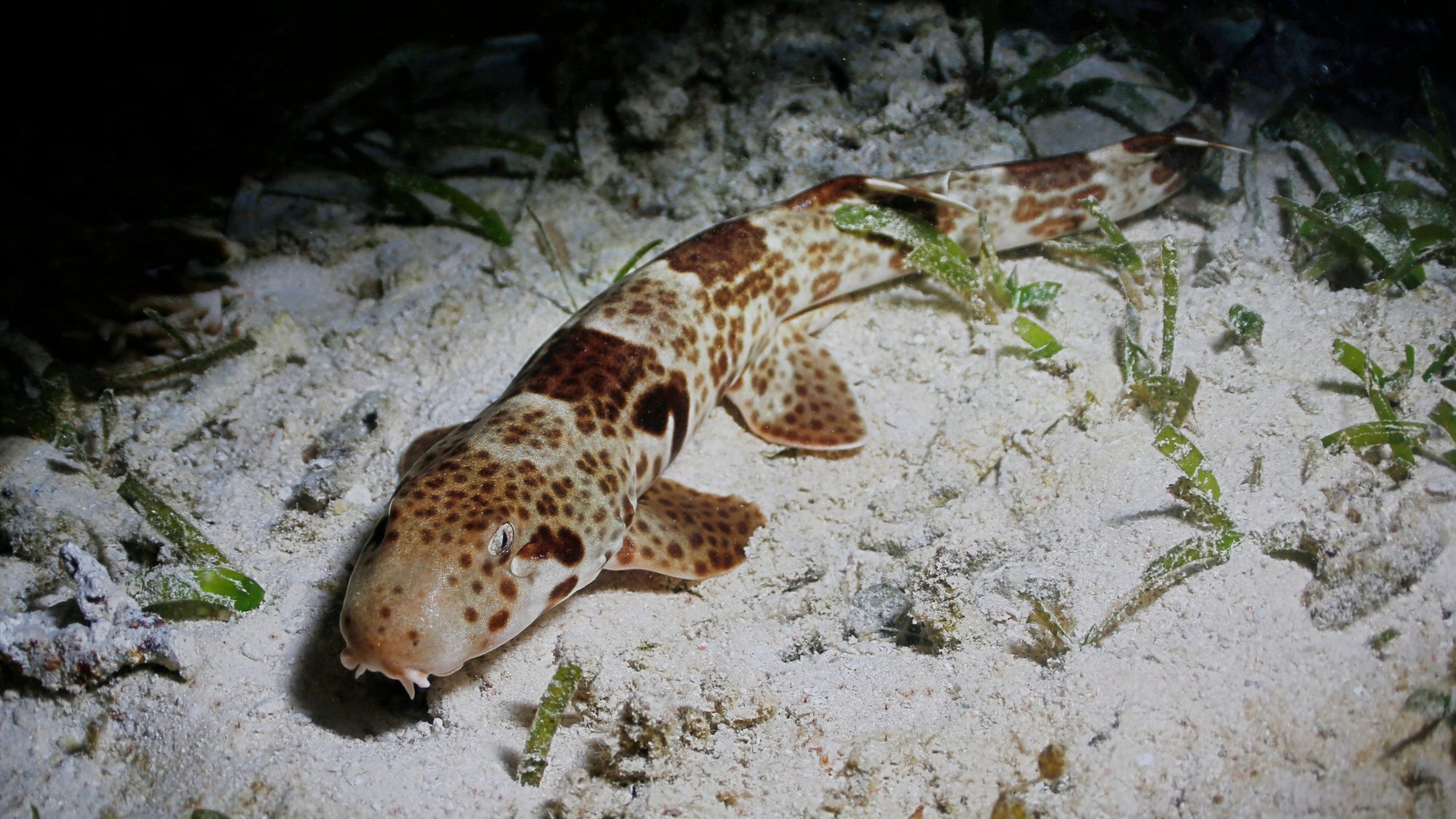
An Epaulette (aka “Walking”) Shark (Hemiscyllium freycineti) in Raja Ampat
The research, just published in the international journal Environmental DNA, introduces a novel genetic primer named ES-200ND4 that specifically targets the mitochondrial NADH4 gene of walking sharks and serves as the key to the study. This marks the first time the NADH4 gene has been used as an eDNA marker in the marine environment. In laboratory tests, this primer has proven capable of detecting walking shark DNA even at relatively low concentrations.
Read the research paper here: “Tracking Fin Prints on Reef Flats: Genus-Species eDNA Metabarcoding Assay for Epaulette Sharks (Hemiscyllium spp.) With Field Validation in Raja Ampat”
Field trial results from the Raja Ampat Archipelago in Southwest Papua in December 2024 have demonstrated the effectiveness of this method. Of the seven testing locations, the endemic Raja Ampat walking shark (Hemiscyllium freycineti), known locally as Mandemor or Kalabia, was detected at six sites.
Most notably, in the waters of Dayan, north of Batanta Island, during daylight hours when the team visually observed no walking sharks, the eDNA method yielded a clear positive signal. This evidence confirms that eDNA can “see” what the human eye misses, especially given that these sharks emerge only at night.
“This eDNA method represents a highly significant genetic breakthrough. The new ES-200ND4 primer we have developed enables accurate detection of specific walking shark DNA from seawater, without the need to capture or even directly observe the individual,” stated Dr. Danang A. Prabowo, a researcher from the Research Center for Biosystematics and Evolution at BRIN, who developed the primer alongside two other researchers from the Research Center for Applied Zoology, Dr. Andhika Prima Prasetyo and Dr. Sutikno.
Walking sharks are known for their unique ability to “walk” along the seafloor using their pectoral and pelvic fins. These species are found only in eastern Indonesia, Papua New Guinea, and northern and eastern Australia, with very limited home ranges, making them one of the most vulnerable shark groups to coral reef degradation and climate change.
“Our field trials in Raja Ampat demonstrate that eDNA can complement the limitations of visual observations, particularly for species that are nocturnal or hide in complex habitats. Now we have a non-invasive and reliable monitoring option for this protected species, including daytime detection,” explained Dr. Edy Setyawan, Lead Conservation Scientist at the Elasmobranch Institute Indonesia and a 2025 Pew Fellow in Marine Conservation.
The Indonesian government, through Minister of Marine Affairs and Fisheries Decree No. 30 of 2023, has granted full protection to all walking shark species. However, implementing this policy is challenging without accurate distribution data. This rapid, inexpensive, and non-invasive eDNA method serves as an appropriate tool to support evidence-based conservation area management.
“This technology offers new hope for science-based conservation, particularly for threatened species. This non-invasive and safe method enables broader and more accurate monitoring while supporting adaptive management of conservation areas. The application of this technology is also expected to strengthen Indonesia’s marine biodiversity monitoring system,” said Iqbal Herwata, Senior Manager of Focal Species Conservation at Konservasi Indonesia.
In addition to walking sharks in Raja Ampat, this eDNA method is expected to be used to detect and map the distribution of walking sharks in other regions of Indonesia, including Halmahera, Cenderawasih Bay, and the waters of Fakfak and Kaimana, or in other countries” concluded Dr. Edy Setyawan.
“Having spent many hundreds of hours surveying for walking sharks at night, often unsuccessfully, I’m thrilled to see this new and highly effective technique developed. I’m particularly pleased to note that the Indonesian team plans to share this approach with colleagues working on threatened walking sharks in remote regions of Papua New Guinea – where it will be exceptionally valuable to conservation efforts there, and a wonderful example of South-South scientific innovation and collaboration,“ noted Dr. Mark Erdmann, Shark Conservation Director at Re:Wild.
The occasion of the International Day for Biological Diversity serves as a reminder that scientific innovation plays a crucial role in maintaining ecosystem sustainability. Amid increasingly complex conservation challenges, approaches such as eDNA offer new, more effective, and less disruptive methods to protect Indonesia’s marine biodiversity.
Media Contact:
Edy Setyawan | edy@elasmoinstitute.id | +62 811 9697 0800
About the Research
This research is a collaboration between the Elasmobranch Institute Indonesia, Konservasi Indonesia, the National Research and Innovation Agency (BRIN), the Raja Ampat Marine Protected Area Management Authority (BLUD UPTD Pengelolaan Kawasan Konservasi di Perairan Kepulauan Raja Ampat), and Re:Wild. This research received funding support from MAC3 Impact Philanthropies, YachtAid Global, Foundation Segré, and The Pew Charitable Trusts.


