







Follow Us!
facebook
twitter
instragram
vimeo
youtube
MENU
  • About
    • About The Bird’s Head Seascape
    • Contact Us
    • Close
  • News-Topics
    • NEWS CATEGORIES
    • Terra Papua
    • Diving
    • Conservation/Science
    • Photography
    • Regional
    • Berita Terkini
    • ReShark
    • Close
  • Galleries
  • Partners
  • Resources
    • Library Research Categories
      • Oceanography
      • Biodiversity, Taxonomy, Ecology
      • Conservation
      • Social Science & Development
    • Media, Fact Sheets & Legal
      • Media
      • Fact Sheets
      • Legislation & Legal Documents
      • About Blue Abadi Fund
      • Indonesian Publications
    • ID Database Projects
        • manta-id-action_btn

        • whaleshark-id-action_btn-300×83

        • Books & Regional Info
        • RAMPAActionButton
    • Close
  • Visitor Info
    • Diving in the Bird’s Head Seascape
    • Travel Information
    • Land Adventures, Guides, and Resorts
    • Procedures for Private Vessels
    • Close
  • Maps
    • Raja Ampat Maps
      • Wayag To Uranie
      • Kawe
      • Alyui
      • West Waigeo
      • Fam Penemu
      • Dampier Strait
      • Batanta
      • Kofiau
      • Misool
    • Triton Bay
    • Cenderawasih Bay
    • Bomberai / Fakfak
      • The Pisang Islands
      • Batu Putih
      • Fakfak and Panjang Island
      • Semai Island & Seamounts
      • Tanjung Turkanggur
      • North Teluk Sebakor
      • Karas Island & Seamounts
      • Tongerai & Toran
      • Momon
      • Cape Papisol
    • Marine Protected Areas
      • MPA: Pratinjau KKP Raja Ampat
      • MPA: Perairan Kepulauan Ayau Asia
      • MPA: Teluk Mayalibit
      • MPA: Selat Dampier
      • MPA: Perairan Kepulauan Misool
      • MPA: Perairan Kepulauan Kofiau Boo
      • MPA: Perairan Kepulauan Fam
      • MPA: Kaimana MPAs
      • MPA: Taman Pesisir Teluk Nusalasi
      • MPA: Taman Pesisir Teluk Berau
      • MPA: Jeen Womom Coastal Park
      • MPA: Cendrawasih Bay National Park
      • MPA: Kepulauan Padaido
      • MPA: KKP Maksegara (Makbon)
      • MPA: TCBFM Teluk Bintuni
      • MPA: KKP Sorong Selatan
      • MPA: Taman Wisata Perairan Raja Ampat
    • Close

Blog Post

Bird's Head Seascape > coral gardening > Rapid Coral Recovery via Symbiont Transfer from Healthy Corals by Daniel Collins, et al
0 Comment

Rapid Coral Recovery via Symbiont Transfer from Healthy Corals by Daniel Collins, et al

21 Oct 2026
Burt Jones
coral bleaching, coral recovery, ecology, environment, initiatives

This research article was published by Science Advances on Oct. 14, 2026.

Due to a number of factors, coral reefs worldwide are in decline.  This article’s findings, while not specific to the BHS, are valuable for all coral recovery/restoration initiatives.  

Read the full article here: Rapid Coral Recovery via Symbiont Transfer from Healthy Corals

Abstract
Coral bleaching, the temperature-induced loss of dinoflagellate symbionts, is a major driver of global coral reef decline. Although corals can regain symbionts through repopulation of residual symbionts or via environmental acquisition, these processes are often too slow to prevent coral mortality. Mechanisms that enable rapid and effective symbiont reintroduction leading to full recovery remain largely unknown. Here, we demonstrate coral bleaching recovery through contact-mediated transfer of symbionts from healthy corals using small coral fragments. We show that symbiont transfer is rapid, occurring over days to weeks, and highly efficient, with only brief physical contact with healthy corals required. A single week of contact, and in some cases as few as 3 days, provides sufficient symbionts to initiate sustained and full self-recovery. By 1 week, symbiont population doubling time is approximately 4 days, up to an order of magnitude faster than most recovery times for corals in the field. We identify tissue fusion as the mechanism enabling directional symbiont transfer from healthy to bleached coral tissue. As a result, contact-dependent recovery is restricted to corals of the same genet, whereas heterologous genet pairings trigger antagonistic interactions. However, symbiont transfer via polyp uptake occurs immediately upon contact in both same-genet and mixed-genet pairings, revealing an additional, slower pathway for symbiont transfer that is insufficient on its own to support colony recovery. Collectively, these findings reveal a previously unrecognized natural process for efficiently reintroducing symbionts to bleached corals, providing a foundation for research into potential recovery interventions.

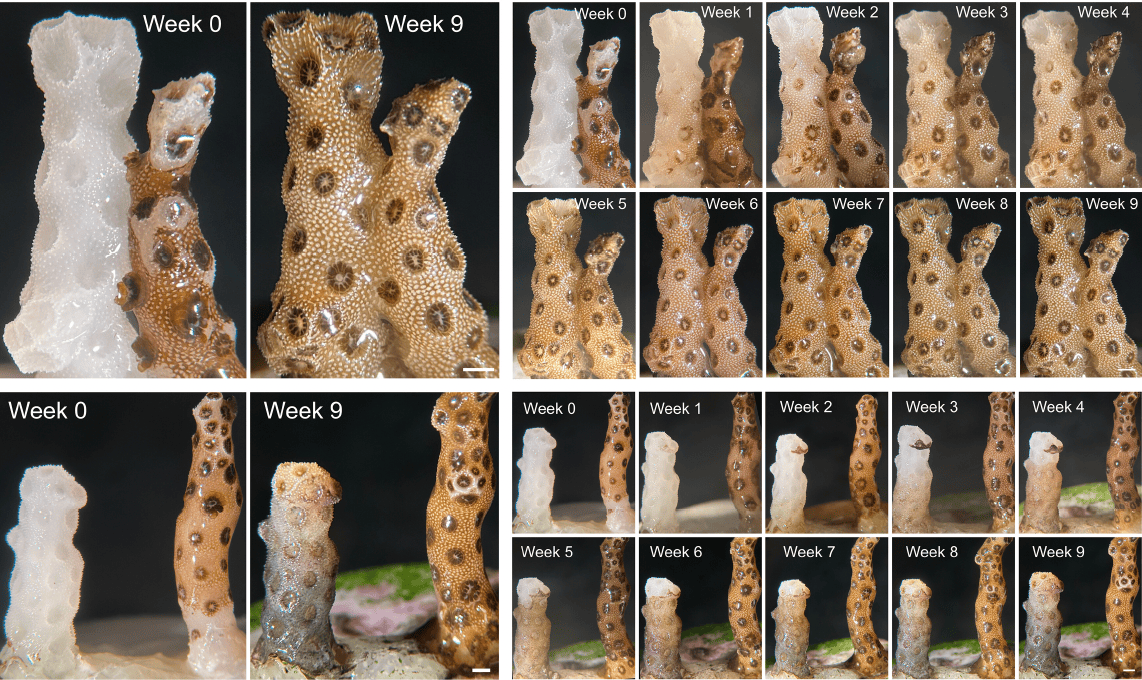
Coral bleaching recovery through contact with healthy coral. (A) Example stereoscopic images of a bleached and healthy coral fragment (P. damicornis) in direct contact, showing weekly progression of coral bleaching recovery from week 0 to week 9. (B) Example stereoscopic images of a bleached and healthy coral fragment (P. damicornis) without contact, showing weekly progression from week 0 to week 9 of external algal overgrowth composed of filamentous red and green algae and diatoms. Overgrowth is characterized by a greenish hue and typically initiates from the base, leading to mortality and minimal recovery

INTRODUCTION
Coral reefs are experiencing global declines as rising seawater temperatures cause widespread bleaching (1). Thermal stress can induce coral bleaching by disrupting the symbiotic relationship between corals and their dinoflagellate symbionts (Symbiodiniaceae), triggering symbiont expulsion from coral tissues (2). These symbionts supply most of the coral’s nutrients through photosynthesis, and without symbionts, corals are vulnerable to starvation and overgrowth by external filamentous algae on the coral surface, often resulting in mortality…

Read the full article here: Rapid Coral Recovery via Symbiont Transfer from Healthy Corals

About the Author

Social Share

  • google-share

Twitter: @BHSeascape

Twitter feed is not available at the moment.

Tags

Berita Terkini Bird's Head Seascape Cenderawasih Bay conservation Conservation Coral Triangle cruising discovery diversity diving ecology education endangered species environment Fakfak illegal fishing Indonesia initiatives Kaimana Leopard shark mangrove Manta Ray Marine Protected Area Misool MPA news new species park rangers photography protected areas raja ampat science Science scuba shark snorkeling sustainability tourism town meetings triton bay turtle underwater photography West Papua whale shark Zebra shark

Categories

  • Berita Terkini
  • Biodiversity
  • Biodiversity/Taxonomy/Ecology
  • Biogeography
  • Birdwatching
  • Bomb Fishing
  • Cetacean
  • Conservation/Science
  • coral gardening
  • Coral restoration
  • Diving
  • Drone photography
  • Ecology
  • Education
  • Epaulette Shark aka "Walking Shark"
  • Forestry
  • Manta Ray
  • Marine Protected Area
  • media
  • Natives
  • Nelayan bom
  • Nickel Mining
  • Painting
  • Photography
  • Ranger Patrol
  • Re:wild
  • Regional
  • Research
  • ReShark
  • Rewilding
  • ReWilding a species
  • Scuba
  • Shark Ray 360
  • Snorkeling
  • StAR
  • Taxonomy
  • Terra Papua
  • Tourism
  • Training
  • Trekking
  • underwater photography
  • Underwater Videography
  • USBA Institute/Institut
  • Videography

Archives

Recent Posts

  • Rapid Coral Recovery via Symbiont Transfer from Healthy Corals by Daniel Collins, et al
  • Teamwork: Oceanic Society and The Sea People
  • Shark Ray 360: ReShark’s 2nd affiliate Project
  • ReShark Ramblings #12 by Dr. Mark Erdmann
  • Update: Chinese Diver Accused of Killing and Eating an Endangered Species from Kompas.com
  • Misool Newsletter: Season 19 has begun!
  • Jangkar-The Indonesian Liveaboard Association, A Valuable Resource
  • The ReSharker Newsletter Issue #9 by Nathaniel Soon, Et al.
  • ReShark Ramblings #11 by Dr. Mark Erdmann
  • Indigenous Community School Development by USBA Institute w/ Terra Papua (English)
  • Sekolah Adat, Bangun Sistem Regenerasi Penjaga Raja Ampat USBA Institut: Siaran Pres (Bahasa)
  • Tourism, climate puts Raja Ampat’s ‘walking shark’ under pressure
©Bird's Head Seascape, All Rights Reserved.